
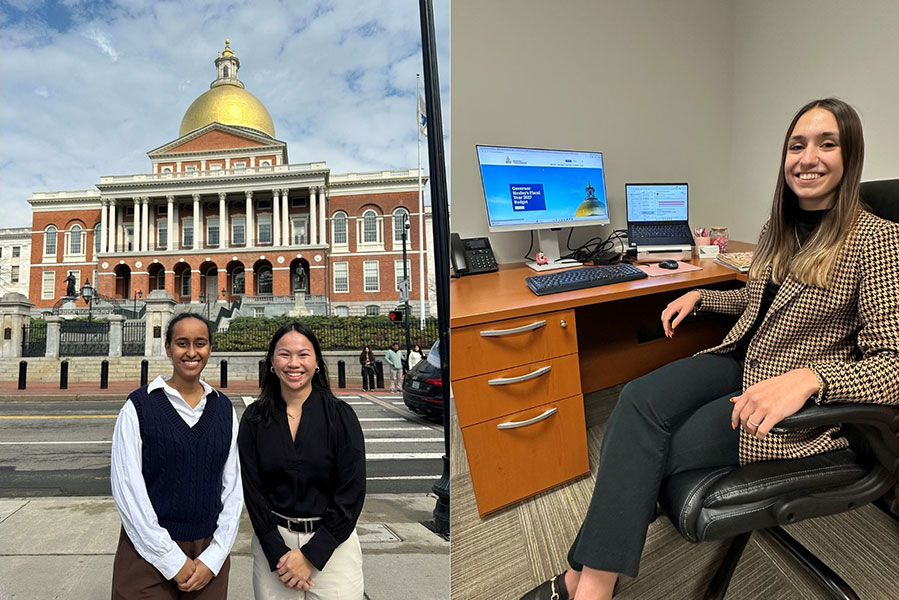
Leedya Senbetta is like thousands of other students who come to Boston to study at one of its world-renowned colleges and universities. After earning her master’s degree in public health at Boston University, she was contemplating a return to the Midwest with no clear plan for what came next. And like students entering the workforce, she knew her interests—but not exactly what she wanted to do with them, or where they would lead.
Then she came across a fellowship opportunity she hadn’t heard of before.
That opportunity — the Policy Start Fellowship — would not only shape Senbetta’ s career but also help define a new pathway into public policy for others.
Founded by the Massachusetts Taxpayers Foundation (MTF) in partnership with the Association of Independent Colleges and Universities in Massachusetts (AICUM), the program is building a pipeline into state policy work—focused not just on experience, but on access. Other fellowship sponsors include Blue Cross Blue Shield of Massachusetts; Boston Children’s Hospital; Comcast; Dana Farber Cancer Institute; Fidelity Investments; Mass General Brigham; and Santander.
The idea for the fellowship emerged about four years ago when MTF began looking for ways to grow its team while bringing in new perspectives.
“We’re always thinking about how to build our team,” said Doug Howgate, president of MTF. “But also, how to increase the diversity of viewpoints and experiences within our work.”
At the same time, AICUM was exploring new ways to sustain collaboration on the heels of COVID.
“Our presidents felt that the level of collaboration had never been higher, and they wanted to find ways to continue that collaborative spirit, said Rob McCarron, president and CEO of AICUM. “Using inclusion as a guidepost, how can we expand who has access to these
roles and opportunities?”
The Policy Start Fellowship (PSF) is a 14-month program aimed at providing opportunities to individuals from historically underrepresented backgrounds into state policy work. To be eligible for the program, participants must have earned an undergraduate or graduate degree from an AICUM-member institution.
At its core, the fellowship immerses participants into the mechanics of policymaking. Fellows analyze state budgets, track legislation, and produce research used by policymakers and stakeholders. Complex policy topics are broken down into manageable work projects, allowing fellows to build confidence while contributing meaningfully from the start.
Beyond the day-to-day policy work, one of the fellowship’s most defining features is the network it provides.
Fellows meet with dozens of professionals across sectors—government officials, healthcare leaders, higher education administrators, and policy experts. Through structured “shadow days,” they gain firsthand exposure to workplaces ranging from the State House to hospitals to municipal offices.
“You see how impactful networking is when it’s put right in front of you,” Howgate said. “It’s not just something you do later in your career—it can shape your opportunities right away.”
These networking experiences do more than build connections—they also help fellows clarify their own interests through a discovery process.
“I wasn’t really sure what I wanted to do after my degree,” Senbetta said. “What drew me in was the professional opportunities—it felt like a strong building block and a way to transition into the workforce.”
Coming from a background in biology and public health, Senbetta said the fellowship helped her understand the broader policy landscape. “I didn’t know organizations like MTF existed,” she said. “The shadow days and networking showed me what was out there.”
Those shadow days—where fellows spend a full day embedded with professionals—became a defining part of the experience.
“You’re not just meeting someone for coffee,” Senbetta said. “You’re seeing what their day actually looks like. There were things I loved and things I realized weren’t for me, and both were valuable.”
One of her most impactful experiences came from shadowing at Boston Children’s Hospital, which later informed a major research project on emergency department boarding.
“It helped me connect what I learned in the classroom to what’s actually happening in the real world,” she said.
Boston Children’s Hospital has hosted each fellow for a shadow day, playing an instrumental role in demonstrating the impact of the state’s public policymaking process on the healthcare system. “We value the emphasis that MTF has placed on the many policy issues affecting children,” said Joshua Greenberg, vice president of government relations at Boston Children’s Hospital. “The shadow day experience is valuable because it gives fellows an opportunity to meet our experts, have a better understanding of the many implementation issues involved in crafting good policy, and, most importantly, centers the needs of children and families in the conversation
For Alex Sheehan, a Massachusetts native and graduate of Worcester Polytechnic Institute who followed Senbetta in the program, the fellowship offered a way to combine technical skills with a growing interest in policy.
“I originally thought I’d go into data analytics,” she said. “But after a semester abroad in Albania working with a community organization, I realized I wanted to do policy work that had a real-world impact. Two of my mentors at WPI pointed out the MTF fellowship as the intersection where my love for data and analytics could be applied into a higher purpose.”
Combining hands-on policy work with intentional networking gives fellows a rare advantage: they enter the job market with both experience and relationships.
For current fellow April Beatty, the program represents both exploration and refinement.
Originally from Rochester, New Hampshire, Beatty attended Simmons University, earning degrees in economics, political science, and public policy through an accelerated program.
“I knew I wanted to work in government, but I didn’t know how,” she said. “The fellowship is giving me a chance to gain experience and figure that out.”
Now several months into the program, her days balance research and relationship-building. She has worked on projects ranging from tracking tax revenues to analyzing transportation funding in the state budget.
“The budget is incredibly complex,” she said. “I learn something new about it every day.”
That complexity has become a gateway to understanding policy more broadly.
“If I’m interested in transportation, I can see how it’s funded and how decisions are made,” she said. “It connects policy ideas to real outcomes.”
Shadow days continue to play a key role. Fellows spend full days embedded in different organizations, gaining insight into potential career paths.
“You get to see what a real day looks like,” Beatty said. “Sometimes it confirms your interests—and sometimes it shows you what’s not the right fit.”
She also emphasized the value of mentorship, including guidance from past fellows.
“The biggest advice I got was to take advantage of every opportunity and be open to learning,” she said.
Looking ahead, Beatty plans to remain in public service, likely at the state level.
In a twist of fate, Senbetta and Sheehan landed not far from each other professionally after completing their fellowships: Senbetta is a fiscal policy analyst for the House Ways and Means Committee while Sheehan serves in the same role on the Senate side. These are positions that offer broad exposure to major policy decisions and future career opportunities.
As MTF prepares to bring on its fourth fellow, for Howgate, success is measured not just in job placement, but in long-term direction.
“The goal is to expand access,” Howgate said. “To help people build networks and gain exposure they might not otherwise have. You hope they leave with a job they’re excited about, but also with a sense of where they want to go—and a network that helps them get there.”
Added McCarron: “For a fellowship, it’s hard to create something truly meaningful. But this has exceeded every expectation.”
For Senbetta, that journey was rooted around what path to follow – and ended up being a tremendous opportunity.
“Everyone from the MTF staff and the people we networked with were invested in our success and wanted us to find the job that was the right fit for us.”
Sheehan summed it up simply:
“The fellowship changed my life.”